Showing posts with label freelance writing for the web. Show all posts

Interview with Connie Brentford: The Moonlighter's Guide to Online Writing for Immediate Income

Thursday, November 08, 2012
We have a special interview for you today with Connie Brentford, the author of The Moonlighter's Guide to: Online Writing for Immediate Income. In 2008 at age 41, she sold her house and everything she owned and bought a one-way ticket to Thailand to start traveling the world, supporting herself with her writing. Four years and over twenty countries later, she and her husband have still not settled down. They're currently in London in the UK, where she's finishing up her fourth and fifth nonfiction books and researching a fiction novel set in London. Connie took time out of her recent London relocation and busy writing schedule to talk with us about her book, The Moonlighter's Guide to Online Writing for Immediate Income.

WOW: Welcome to The Muffin, Connie. We appreciate you coming by to talk to us about your book, The Moonlighter's Guide to: Online Writing for Immediate Income. What inspired you to write this book?

Connie: Thank you. It's great to be here! The inspiration for this book came to me over a two-year period of travel. I have been traveling the world supporting myself with my writing income for several years now; and in each place I visited, people would ask me how I do it. I was asked over and over again to teach people how to make money writing. Even if they didn't want to travel like I did, they saw the potential for extra income and were excited. These folks had a desire to write and make money, but very little writing experience. In these coaching sessions, we had to take it back to grammar school and go over things like sentence structure, paragraphing, and the difference between your and you're. Once that was done, I would teach them about up-front pay, residual pay, and the different types of content writing. I would coach them as best I could for the short amount of time I was there. This was the impetus for the book. I started thinking about how I could reach more people who would like to try freelance writing and what you really needed to know before you started trying to make money as a content writer online. Now when I'm chatting with a fellow traveler in an airport who expresses an interest in writing for a living, I just hand them my business card, and they can buy the book and follow up with me if needed.

WOW: Great plan! Who is the perfect audience for this book?

Connie: The novice writer, college student, the stay-at-home mom or dad who needs extra income, the retired person who has always wanted to write, or the person looking for a portable job. I make the point in my book that even if you've never written a word, it doesn't mean you're not a writer. So many people have the desire to write and just don't try. They don't realize they could potentially be a great writer, make a great income, and live the lifestyle they've dreamed about. I thought about writing for years before actually putting pen to paper. I want my book to be their excuse to try it.

The unemployed or underemployed would benefit from my book as well. You will make money as a freelance writer even if it's just a part-time endeavor. The Internet is the largest employer right now. It thrives on content, and writing content is a recession-proof job. One thing I don't hear on the freelance writing forums is there is not enough work. There are always writing gigs if you know where to look.

WOW: Well, that's good news! The second chapter of this book is "The Five Things You Absolutely Need." Can you share a couple of these with us now, and why they are so important for online writers?

Connie: A few years ago I read a freelance writing book that said you needed sharpened pencils, a filing cabinet, fax machine and billing software, among other things, to start freelance writing. This writer also mentioned that if you were unsure about your writing skills, you should start submitting articles to magazines and if you received twenty to thirty rejections, your writing might need some work. This is so daunting for someone just starting out, especially if it's a stay-at-home mom on a limited budget. The truth is, you don't need any of those things when you start. You should, however, take the time to brush up on your writing skills before you start. My book helps with that, and it offers resources for further reading and practice if you're still unsure. I personally owe a debt of gratitude to Mignon Fogarty for her Grammar Girl podcasts. If I had received thirty rejections when I started, I would have quit, not stopped to brush up on my skills.

Here are two essential things you really need when you are starting out:

Time to write: If you can't devote at least two to three hours a day in the beginning, this business won't be sustainable for you. If you don't show up and write, it won't happen. With six children, I know what it's like to have a busy home life, but writing has to be more important than a television show or an extra hour or two of social media surfing each evening. You are the only person that can change your daily patterns to make time for your writing career. Make the time to write each day, and you will succeed as a freelance writer.

Consistent computer and Internet access: When I started out, all six of my children were still at home. We had a few computers in the house, but they were shared. Even the one that was designated mom's writing computer was usurped at a moment's notice for a school paper or teenage daughter drama. You need consistent access to your computer preferably in a quiet place for your writing time. You will have deadlines so have a back-up Internet source like a coffee shop if yours is unavailable. It's important!

WOW: That's a fact--it's hard to do your job without the proper tools. I love that you mentioned your six children, by the way. I know that will be very inspirational for some readers. I'm sure someone is thinking: If she can do this with six children, surely I can do it with two (etc.). In your book, you also discuss the two kinds of pay: up-front and residual. Which should online writers seek and why?

Connie: There are good earning opportunities in both!

When you're starting out as a content writer, your goals are to provide quality content for your client and put money in your bank account. You get a one time payment for your article from your client, and you usually relinquish all rights to that content, meaning you cannot earn money from it again and sell it to another client. That's called up-front pay. I actually don't like the term because it implies you get paid before you write the piece. In truth, you get paid when your client approves the piece.

Residual writing income is from articles you write and place on your own website or another revenue sharing website like Squidoo.com. You earn money from these articles month after month because in and around them, you have affiliate links and Google Adsense ads.

Each type of writing requires work beyond the writing of the piece itself. Those seeking consistent up-front pay must hustle for clients, query, and write. Good residual income comes from knowing how to create traffic for your own website or the revenue share site. You must know how to market these articles, so they are seen, thereby increasing their visibility and your revenue.

Because Amazon has opened up the indie writing market, many freelance writers, especially those that ghostwrite e-books, have successfully created their own e-books to sell on Amazon.com. Book revenue is just another form of residual writing income because you have to know how to successfully market your books in order to make income from them.

WOW: Makes sense. Thanks for explaining the two terms. Why is it important for writers to create a revenue goal? How do they do this?

Connie: When I was researching my book I wanted to use more than my own experience for an example, so I went in search of other content writers making money and asked them questions. One thing almost all of them do is make weekly and monthly revenue goals. For the most part, those I interviewed were hard-working, stay-at-home moms writing when their children were in school or in bed. Each week, they knew how much money they wanted to earn from each of their eggs. An egg is just another term for a writing gig. Their gigs were usually a mixture of writing for online companies, private clients, and residual writing for their website or a revenue share site. If one week underperformed financially, they would adjust the next week to earn more, so they still met the monthly goal. The trick here is to have enough eggs in your basket to call upon to meet your monthly income goals. If needed, they would check websites, like www.online-writing-jobs.com, for quick, one-time gigs. Clients and online companies go through slow periods like any other business, so collecting writing gigs is key to meeting your income goals. Some writers get stuck in a rut writing for content mills, which tend to be lower paying, so their income never really goes up. It's fine to write for these companies in the beginning, while you're learning the different styles of content writing; but once your skills allow, you must pursue private clients and other types of writing jobs to increase your income. Once you do this, you'll end up working less hours but for more pay.

WOW: I think that's the goal for most of us! A large portion of your book is actual online sites, where writers can find paying jobs. How up-to-date are these links? Can you give us a couple of sites here for WOW! readers to start looking in to?

Connie: I update the book at least twice a year. The companies and the writing markets open and close, rearrange their websites, and change how and when they pay; and I want the reader to have timely information. I don't always put the brand new writing companies in the update because I need time to see that the companies are offering solid work, and writers are actually getting paid.

I have heard good things about Remilon. They pay writers to write education-related articles, and they have a specific article format they use, which can be helpful to newer writers. Their starting pay is $8/hr; and as you improve, you get a pay raise. They require fifteen hours of work per week, so you get the value of seeing if writing at home is for you without it being overwhelming. What's different about this company is they pay you for the time you're researching, writing, and editing; so if you're new and a little slower, this works to your advantage. They have editors that work with you as well to improve your writing skills.

If you'd like to try a residual form of writing income, I would recommend Examiner.com. There is a learning curve that comes with hosting and installing your own website, and sites like Examiner allow you to post on a subject you are passionate about and earn money based on page views without having to learn webmaster skills. One of my favorite Examiners is Lynn Farris (http://www.examiner.com/mystery-books-in-national/lynn-farris). Her passion is reading and reviewing mystery novels, and she has created a great Examiner.com page that people in the mystery book reading circles love. She works hard and smart to market her writing on Examiner by using social media.

WOW: I didn't realize that's how the site worked. Thanks for sharing that! Readers will want to know how you figured out how to make money writing--in other words, a little bit about your personal story. Can you tell us how you got started writing online and creating a full-time income for yourself?

Connie: It really started years ago when I was a stay-at-home mom. My husband is a writer as well, and I would proofread his books and blog posts. I realized that I caught a lot of errors in other peoples' writing, and I should probably try it myself. My children were also leaving the nest one by one, and I admit I felt a little panicked about what was next in my life. I created a travel blog with the intent of making money as a full-time travel blogger. It was much harder and much more work than I thought, and I was hardly earning any money at all. So I started writing for a few of the online companies and learned how to write different styles of content, like press releases and SEO writing. I took that knowledge and started seeking out short-assignment, private clients on sites like Craigslist.com and Guru.com. I started to specialize in ghost blogging for travel blogs. Because of my travel experience, this type of writing didn't even feel like work to me, and there was plenty of work available. It became the bulk of my income; and over time, I was able to raise my rates to the point where I was working about twenty hours per week making a full-time income. One thing I learned as I went from new writer to seasoned writer is that there are clients at every level that are willing to pay your rates.

WOW: Great advice, Connie! Anything else to share about yourself or your book?

Connie: I didn't start writing seriously until I was in my forties, so it's never too late to get started!

In 2010, I wrote my first book and self-published it on Amazon.com, and I have written three more since then, all with the theme of ways to leave your current job and work from home. I attribute the success of my books to the skills I learned as a freelance writer. I have stepped back from the freelancing a little to focus on coaching others in the self-publishing process. I just helped a friend in Belize publish his memoirs on Amazon.com, and it has provided a steady passive income for him that is practically unheard of in developing countries. It's a fine time to write and publish a book, and so many people have a story to tell.

I still continue to make money from my writing and travel with my husband. We've been traveling perpetually for almost five years now with no intention of stopping. The term used to be digital nomad, but now the term location-independent has taken its place. I am so thankful I have a job that allows me the freedom to live this lifestyle. The writing life can be hard in the beginning, but it's also grand; and I'd like everyone who wants it, to have it.

WOW: Thanks, Connie! I'm sure our readers can tell just from this interview that your book, The Moonlighter's Guide to Online Writing for Immediate Income, is going to be full of useful tips and great resources.

Find out more about making a living as a work-at-home writer by visiting Connie's website: www.themoonlightersguide.com

We have great news, too--THREE e-books to giveaway! 

Fill out the Rafflecopter form below for a chance to win a copy of The Moonlighter's Guide to: Online Writing for Immediate Income! Open internationally.

a Rafflecopter giveaway


Good luck!
Read More »

Supplement your Income with Internet-Based Freelance Writing Jobs, Guest Post by Brian Jenkins

Tuesday, February 08, 2011
Freelance writing jobs abound for talented writers who are willing to seek them out on the Internet. Writers can sell their talent on the Web instead of just sitting back and waiting for book sales! Some freelance writers use job market websites to earn additional income. However, these websites typically use a bidding system for writing projects, so the pay is typically low because of intense competition between writers. Let's take a look at some good Internet-based, part-time freelance writing job arenas:

Women's Magazines with an Internet Presence

One handy website, Freelance Writing, provides a list of women's magazines that accept submissions from freelancers. The list includes a short description of each magazine, including their websites, as well as submission guidelines.

Copywriting

The success of many online businesses depends on creative advertising. Because of this, a talented copywriter can make a decent income. Companies seek talented writers to develop scripts for advertisements, promotional materials, landing pages, and public relations materials. They are also called upon to write short, informative articles. Some Internet copywriters develop original scripts for audio or video advertising campaigns.

Greeting Cards

Some greeting card companies accept submissions from freelancers. Blue Mountain Arts, for example, pays freelancers as much as $300 for a short verse. The greeting cards sector is a good niche for poets and for writers with good senses of humor. Freelancers may improve their chances by offering ideas for a specific audience, such as novelty cards for kids.

Here are links to the submissions guidelines for some of the greeting card companies that accept submissions from freelancers:


Electronic Newsletters

A variety of companies and organizations send newsletters via email. Basically, these jobs involve writing articles, providing relevant information about the organization or it's industry, and perhaps conducting interviews. Depending on factors such as the importance and size of the organization as well as the frequency of the newsletter, you can make anywhere from $1,500 to $6,000 per newsletter.

Blogging

Freelance writers can blog part-time to add to their income. To help make it easier to find these opportunities, there are numerous websites that post blogging jobs. Visit Problogger's jobs web page and the Freelance Writing Jobs Network. Both of these useful websites post a wide variety of blogging jobs.

Some blog-based websites hire bloggers onto their staffs. b5media, based in Toronto, operates a wide variety of blogs. Their bloggers get paid from $100 to $250 per month based on the quality of their blog posts as well as their experience. However, they also can get bonuses, and these are connected to the traffic their blogs receive.

Many freelance writing jobs can be performed on a part-time basis, which leaves plenty of time to write about other topics you enjoy.

*  *  *

Brian Jenkins writes about a variety of career and job search topics for BrainTrack.com. His writing experience also includes developing marketing copy, publishing web pages, blogging, and writing a wide variety of informative web-based articles. Brian has written numerous online-based press releases for a variety of companies.
Read More »

Bright Hub is Looking for Writers

Wednesday, September 15, 2010
We welcome Kelly Walborn, who is the director of training for the website, Bright Hub. They have several new writing opportunities they would like to share with WOW! readers. Kelly explains how to apply to Bright Hub, what types of writers they are looking for, and most important of all--how writers are compensated!

WOW: Welcome, Kelly, and thanks for talking to The Muffin readers today about Bright Hub. I know several of our readers are wondering all about your company and writing opportunities. What type of writers is Bright Hub looking for?

Kelly: We look for bright (!) subject matter experts who have a penchant for writing informative and engaging articles. Previous online writing is certainly a plus, as articles must appeal to both the prospective readers and the search engines. But we do train our writers to follow our particular SEO strategy.

WOW: You mentioned you need writers who are subject matter experts. So, what is the content that Bright Hub writers write about?

Kelly: Bright Hub writers focus on solving a problem or offering valuable and sought after information for the specific audience that is targeted by the article. Our team of editors thoroughly research appealing topics, and offer a continuous selection of writing opportunities for writers to choose from. This way, writers can truly focus on their areas of expertise. We just opened a whole bunch of new Health, Mental Health and Home Schooling channels, and we’re always opening more. Writers can see which channels are looking for writers at http://www2.brighthub.com/writers/hotopportunities.html.

WOW: Sounds great! So, if writers are interested in any of these opportunities, what is the application process like?

Kelly: Writers apply to a particular channel (like Diabetes or Heart Disease in the Health hub) by completing an application and submitting a writing sample. Often, writers will submit a previously published piece, so it’s important to indicate that during the application process. They can go directly to the applications here: http://www2.brighthub.com/writers/writerswanted.html. Once approved, they are welcomed to the community by their Managing Editor and are given access to orientation and training materials.

WOW: Thanks for explaining the process. It sounds simple. You mentioned that there are training materials. So, is there training available? How intense is the training process?

Kelly: We do make a point to offer continuous training to our writers, and we have a multi-tiered model for that. Bright Hub staff deliver webinars and written training on our policies, tools, and strategies. In addition the editors, who are community members just like writers, often mentor on best practices and quality improvement. We are continuously improving our training – both the content and the efficiency of how we deliver it to writers.

WOW: How are writers compensated for their work on Bright Hub? Are they given a byline also?

Kelly: Bright Hub writers always get a byline for their individual articles and can choose their own display name and set up a profile page for interested readers. We offer two different compensation models – one is entirely based on shared revenue and the other involves an up-front fee for each article plus a group revenue share. We offer a comparison of these models here: http://www2.brighthub.com/writers/comparison.html


WOW: Thanks for all the links and information! In your opinion, what are two reasons why writers should check out Bright Hub's opportunities?

Kelly: Just two? (smiles) Bright Hub is known for providing substantial community support to our writers. Unlike other sites, writers are not working in a vacuum or lacking in accessibility to resources. Another good reason is that Bright Hub is a credible site and can really help quality writers hone their craft and get noticed.

WOW: Thank you, Kelly, for taking the time to share with us all about Bright Hub. We appreciate it immensely!

interview by Margo L. Dill; http://margodill.com/blog/
Read More »

SEO Sundays: How to Write Key Words

Sunday, November 11, 2007
Keywords for Webmasters AND Freelance Writers

I admit I’ve been a little lax on “SEO Sundays,” but I’m back in the saddle again thanks to a little prodding. Ouch!

Today I’m going to talk about keywords, both in your meta tags, and in the articles you write. So, don’t skip out yet! This is something freelance writers should know about, not only webmasters.

As a freelancer I’m sure you’ve seen job postings that read something like, “We need a freelance writer to produce 5-10 keyword articles per week.”

In fact, if you’re a freelancer writing for an online publication, this has become the industry norm. So let’s start at the beginning.

The Gist

Not too long ago, there was a high demand for SEO copywriters. These wizards optimized your web pages by miraculously picking out a few keywords that boosted your ranking on search engines.

I’ve even had a team of these wizards approach me about WOW! saying that they’d optimize my website by creating a custom tailored set of 20 key words per year...for the small sum of a couple grand. Oh gee, thanks...but no thanks. Even when I was green that just didn’t make sense to me. I told them, “I doubt you’ll know my site better than me.” That was less than a year ago, and things have already changed.

Meta Tags aren’t all what they used to be

Search engines are no longer treating keywords as significant in your metadata. They tend to ignore the meta tag’s keywords and look to the actual page content. This is why it’s important to plan out your content before you write it and develop a set of keywords.

It used to be that you could plop 20 keywords, or 1,000 characters into your metatags and that was it. But when you think about it, this really doesn’t make much sense. If it were that easy, don’t you think people would just write anything on the page, not really caring what they wrote, and then put the real thought into their tags and not the content? Well, that’s what happened, and search engines had to be smarter. Granted, I still faithfully make a set of metatags for each and every new page/article on our website... just in case. So, let’s go over a few pointers—I wouldn’t want you to dismiss them all together because that wouldn’t be good advice. Things such as the “title” section of your metatags have more weight than any other part, so indeed, they’re necessary.

Tips for Building your Metatags

These are some basic guidelines when building metatags for your static website. Meaning, if you have a blog, you don’t really need this part, you’ll most likely have to concentrate on your content, and that’s coming up.

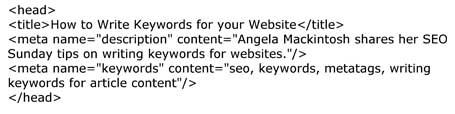
What metatags look like:


They all fall within the beginning head tag and head enclosure.

Note: There’s also a “robots” description that I didn’t add because for the most part, robots will follow the index automatically unless you tell it not to. It was created in 1996 and is meant to provide users who cannot upload or control the robots.txt file at their websites for the purpose of keeping a website’s content out of search engines.

STEP 1: The Title Tag

You’ll see some websites that have the same title tag throughout their whole website. I was guilty of this when I first started out. I’d put the same thing into each page of our website: WOW! Women On Writing is an Ezine that promotes the communication between women writers, authors, editors, agents, publishers and readers.

Yikes! For one thing, I quickly discovered that was way too long (too many words), and not descriptive enough for each page.

Length:

Standard practice says that the title tag of a page should describe the article in no longer than 65 characters, or 6-8 words.

Keyword or Phrase:

Put the keyword of the article or phrase into your title tag. Use your keyword once.

Examine your article:

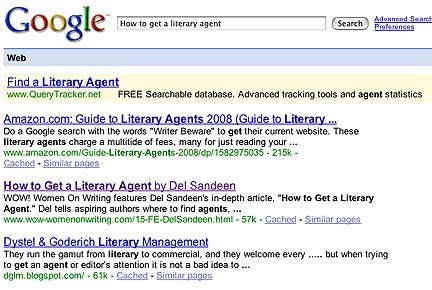
Think of it this way: if you were doing a search on Google for a specific subject, such as, “how to get a literary agent,” wouldn’t you just type that in and see what comes up? It’s common sense.

Take a look at your article or the content of the page.

• Who are you trying to reach?
• What phrase might they type in?
• What subject is your article trying to relay?
• Get to the meat of it.

Whatever you do, make sure that phrase or keyword is actually in the article.

Tips:

Remember that the title is the most important part of the metatag. This is what you see when you do a search. It’s the part that’s underlined and highlighted in bold (if that’s the term you searched for). All search engines bold your keywords.


Now remember, if you did a search on what I mentioned up above, “how to get a literary agent,” you’ll see that the article we just published by Del Sandeen a little over a week ago, which appears on page 3. That’s because it’s so new. Give it another month or so and it may appear on the first page. Static websites take much longer than blogs. But remember it’s also the content you’re searching for. The more common the phrase the higher likelihood that your page will be pushed back in ranking because of timeframe and relevance.

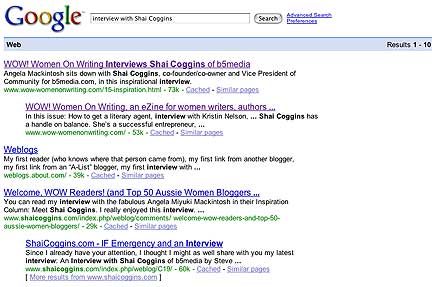
Yet, sometimes content can be so relevant on a static website that it shows up immediately. When I typed in: “Interview with Shai Coggins” (Note: From this month’s inspiration column) you can see we took the top two spots. Even before Shai’s website or b5media’s website.


(Note: see where it says in the upper right hand bar: Results 1-10 of about 16,000)

STEP 2: The Description

After you see the title on a search engine, right beneath it comes the description. It’s the blurb of what the article is about and how you’ll most likely decide whether or not to read that article.

Be honest:

That’s what I’ve found to work. Give a blurb of what’s included in the article (only the key points, or keywords) and describe it in no more than two sentences. You’re all writers, get to the meat of it!

STEP 3: The Keywords

Like I mentioned before, these tags aren’t cruised much by search engines anymore because they’ve been diluted. Most of the time search engines will crawl content before keywords – but there still is a necessary place for them.

Length:

Limit your keywords to no longer than 1,000 characters. Some meta tag generators use 20 key words or so, but it depends on your keywords and phrases.

Commas?

There has been some debate about whether to use commas in between your keywords. I prefer to use them, but others do not. This is because eliminating commas may increase your odds of search engines extracting different phrases from your keywords.

For instance, if your tag is "literary agents nonfiction book proposal" you might get ranked for "literary book proposal" but if the tag reads "literary agents, nonfiction book proposal," you'd have less of a chance to get ranked for "literary book proposal" because the comma separates the words.

That’s up to you. I prefer to use commas and phrases for my keywords.

Angela’s Secret Tip:

Here’s a personal tip I use for extracting keywords—and this can be used in your freelance writing for internet publications:

• Open MS Word
• Read your article and examine the key point you’re trying to get across
• Go to the “Edit” menu at the top and click on “Find”
• In the box that says “Find what” type in your keyword
• Check the box that says “Highlight all items found in” (and the dropdown box only has one choice: “Main Document”)
• Click the “Find All” button

This will immediately show you how many times that keyword is used in your article. It not only highlights the word in your article, it gives you a count right there in the box!

Take out a notepad and write that word down with the number of times it was used.

For instance: if I used the “find” tool right now to search the word “keyword” it comes out to: 34

That’s quite a hefty sum for one article!

So, examine your words and phrases, pick out the most relevant, do an MS Word Find, and tally your content. I know this is time consuming, but if you’re going to be getting paid top-dollar for your freelance writing (or if you want to), or own your own website, then these are important things to consider. Attention to detail will only help you in the long run.

Freelancers: Content is Queen

If you just scanned and cruised in because of the bold captions, do yourself a favor and read the tip up above. That applies to you!

Not a Copywriter? So what!

Truth is, keyword articles pay well. Why not learn how to roll with the times and get paid for your writing. By incorporating a few extra steps, you can make a lot more as a freelance writer.

You’ve all seen the job boards and listings for “keyword articles” – well, it’s not much different than writing a regular article. You just have to inform yourself, and soon you can be an expert.

If you’re a fiction writer:

Throw out what you know about fiction for your freelancing gigs. Throw out what you’ve learned about the dreaded “echoes” in your work, and make those echoes count. They are an important part of what will bring you the green.

As fiction writers we know it’s not good to repeat words, phrases, or even hint at the same words. Those echoes always meant that we were sloppy writers and didn’t have the capability to be descriptive. The opposite applies when you’re writing for the web. The more you can incorporate your keyword in a unique fashion so that the reader doesn’t realize it’s happening, the better.

As a fiction writer myself, I know this is one of the toughest things to do! But, think of it this way: you’re allowed to break the rules, so take advantage.

Keep your audience in mind:

When writing keyword articles, the most important thing to keep in mind is that the articles must be interesting to the target reader. Your articles should be filled with relevant content so that the reader won’t quickly move onto the next website. Give them valuable information, just like you always would.

As well as Search Engines & your Client:

Determine what your employer is trying to relate, then think of copy that will help enhance their traffic. Put yourself in their position. If you were someone searching for her particular product, or looking for some information on a specific subject, what would you search for? What keywords would you type into a search engine?

Writing it Out!

Remember not to overload your article with too many keywords. When writing your article, choose one main and two secondary keywords.

Here are a few tips to follow:

• As I mentioned earlier, make sure you include your primary keywords and phrases in your title.

• Repeat your main keyword in the first sentence of your article.

• Include your keyword as much as you can in the first 150 words of your article, as long as it’s readable and not ridiculous!

• Spread your secondary keywords throughout the rest of your copy.

• If you are writing a long article, make sure that you include your main keyword or phrase every 150 words or so at least twice.

• Include your keyword or phrase in your conclusion paragraph.

Remember your good writing ethics:

Write what sounds good and be creative when incorporating those words. Think of it as a challenge. Test yourself to see how creative you can be within a limited structure. By viewing it this way, it can be fun!

Summing it up:

Writing a keyword article is just like writing any other article. The only difference is that you’re challenging yourself to include certain words. Think of it like a prompt-based contest. You’re given a certain topic to write about and you must incorporate those words and ideas into your story. And I know all you ladies have the capability to do that, so why not try your hand at keyword articles. You may develop a unique ability to become an expert at something you’ve never thought of. Add that to your bio! And some green to your pocket.

----------

Find out more “tips & tricks” when you subscribe to Premium-Green Markets: The Women’s Freelance Guide to Writing and Markets. First issue coming up this week!
Read More »
Powered by Blogger.
Back to Top